
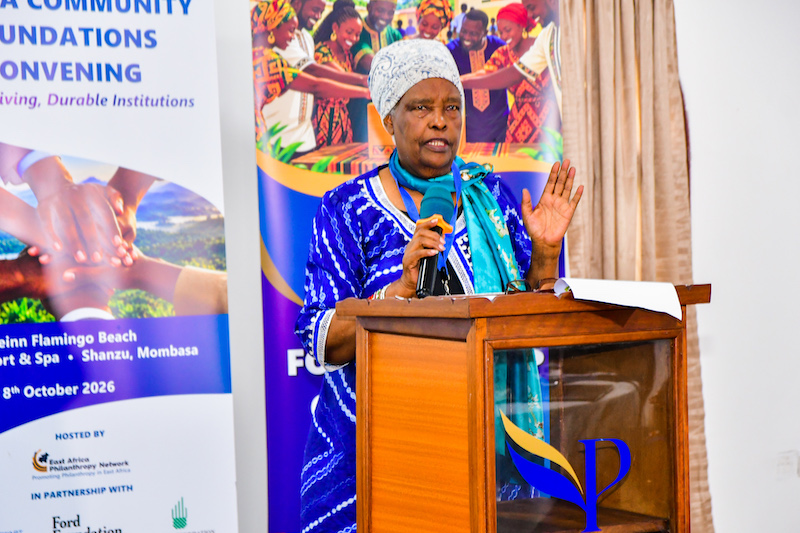
With that call, Monica Mutuku, founding CEO of the Kenya Community Development Foundation (KCDF), set the tone for the first full day of the inaugural Africa Community Foundations Convening on Tuesday 6 October 2026. Held from 5 to 8 October 2026 at the PrideInn Flamingo Beach Resort and Spa in Mombasa, Kenya, the convening brought together around 80 participants from community foundations, support organisations, funders and research institutions across Ghana, Kenya, Malawi, South Africa, Uganda, Zambia and Zimbabwe, under the theme Rooted in Community, Built to Last: Africa’s Community Foundations Come of Age.
Why community foundations, why now
Delivering the keynote, Why Community Foundations? Why Now?, Mutuku drew on nearly three decades of building one of the continent’s first community foundations. Her starting point was a conviction formed through years of work with communities. “Poor people are not helpless,” she said. It is the system that fails them. Organised communities, she argued, can drive their own development even where the system does not work for them.
That principle shaped KCDF from the start. It was built as a development organisation rooted in communities, not a copy of the Western model where building an endowment is the main goal. Mutuku stressed that development lies in the process, not just the end product, and that ownership is what makes change last. She also pointed to the link between institutions and development. “If there are no institutions, there is no development, and the people are suffering,” she said. Strong boards, sound governance and regular audits are what turn community giving into lasting institutions.
Giving, she said, is not foreign to Africa. It is reciprocal and deeply rooted in how communities live. The task now is to institutionalise it, so that it is trusted, accountable and built to last.
The practice is ahead of the infrastructure
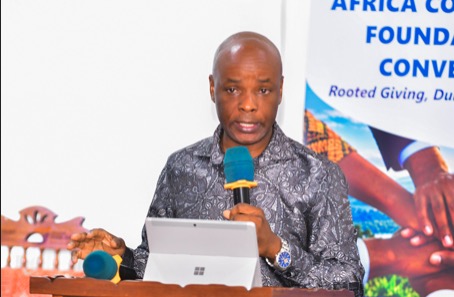
Opening the day, Evans Okinyi, Director of the East Africa Philanthropy Network (EAPN) and host of the convening, named the challenge the movement faces. “In all the countries represented in this room, the practice is ahead of the infrastructure,” he said.
Communities are already mobilising assets and setting their own priorities, Okinyi said. What is missing is the architecture that makes this practice durable: governance, capital, enabling regulation, grant-making capacity, evidence and long-term support. The gap is growing more urgent as development financing becomes volatile and many local institutions still depend on short project cycles and restricted funding in a shrinking regulatory space.
Funding alone will not close the gap. “Capital alone cannot solve the infrastructure gaps that we have identified,” he said. He also called for communities to have a real voice in decisions. “We cannot base development in communities and not allow these communities to sit at the tables where critical decisions are being made.”
Okinyi was clear that Mombasa had to produce results. The organisers did not want the convening to be “another talk and talk.” Success, he said, means leaving with a shared pathway for community foundations to mature, clearer routes to capital and a stronger link between practice and policy.
Under the baobab
Screenshot
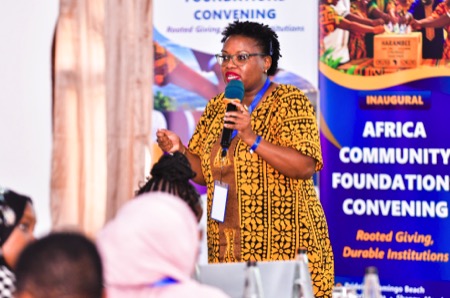
Grace Maingi, Executive Director of KCDF, then framed how the four days would tackle that challenge. She used the image of the baobab tree, a symbol of resilience and a gathering place across Africa, “a place that is large enough for all of us.” Its roots represent place, its trunk governance, its branches permanence, and its fruits grant-making and capacity support. “If your roots are weak, do you survive?” she asked.
Maingi set out four goals for the week: a stronger shared identity for African community foundations, practical peer learning, solidarity across borders, and agreement on priorities beyond Mombasa. Delegates named what they wanted to leave with and what expertise they were willing to share, building a pool of peer support the movement can draw on.
Her challenge to the room was honesty. “If we are not open, honest and vulnerable, we will not know what we need,” she said.