
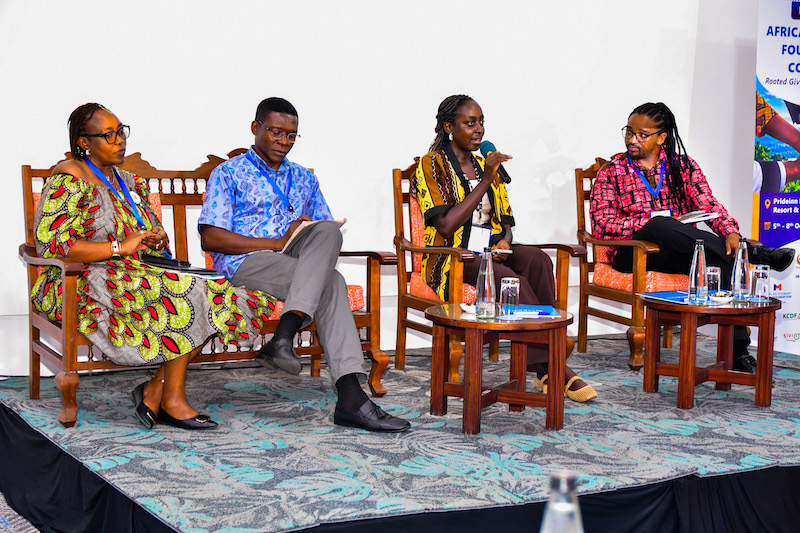
Five years ago, three researchers set out to answer a question the development sector kept asking: does the community foundation model make sense in Africa? What they found changed how the movement sees itself.
On Tuesday 6 October 2026, at the inaugural Africa Community Foundations Convening in Mombasa, Kenya, Susan Njambi, Team Lead at Lusoma Advisory, Dr Ben Ocra of the Ghana Philanthropy Forum and Madonna Vicky Ainembabazi of GivingTuesday reflected on the feasibility studies they led in Kenya, Ghana and Uganda. The session, Testing the Ground: What Feasibility Studies Revealed About Building Community Foundations, was moderated by Jeremy Maarman, Executive Director of Uhuru Creations.
The label and the practice
Drawing on the Kenya study, Njambi shared an important insight: the absence of the label “community foundation” does not mean the absence of community foundation practice. Many communities are already organising, mobilising resources, making decisions and stewarding assets in ways that reflect the model.
Ainembabazi’s experience in Uganda showed the other side of the coin. Carrying the name does not make an organisation a community foundation. In just two districts, dozens of organisations called themselves community foundations without the defining features. In Ghana, Ocra found that the few organisations listed as community foundations were in fact corporate foundations controlled by a few people. He also noted that while demand and a strong culture of giving were clearly present, giving alone was not enough to build lasting institutions.
When Maarman asked what would have happened if the studies had found no community foundations at all, the panel agreed the answer could never truly be zero. African cultures have long built systems of giving that benefit people in a place, including the practice of keeping seed for the next season, the same logic behind an endowment.
What makes a community foundation distinct
For Njambi, community ownership is what sets a community foundation apart. Community foundations are rooted with and in communities, with ownership, accountability, collective decision-making and local resource mobilisation at their core. Ocra pointed to the conditions that help them succeed: community demand, the ability to raise resources and build assets, an enabling policy environment and strong governance. Ainembabazi stressed the need to centre collective giving and local resources rather than external agendas.
As the movement grows, Njambi cautioned against losing this identity: “Please, don’t change and become an NGO.” She also highlighted the importance of documenting African community philanthropy practices, an area where Lusoma Advisory and the East Africa Philanthropy Network (EAPN) have been contributing.
Building models that fit
The conversation raised an important question for the sector: should African community philanthropy be made to fit existing models, or should the sector build models that reflect the realities, practices and aspirations of African communities?
For the panel, the answer begins with listening to practice, documenting what exists, learning from communities and strengthening the infrastructure that helps community foundations grow and remain rooted.